Upcoming Event: PhD Dissertation Defense
Data-Driven Optimal Experimental Design and Uncertainty Quantification with Applications in Computational Imaging
Evan Scope Crafts,
2 – 4PM
Wednesday Jan 28, 2026
Abstract
The inverse problem framework mathematically formalizes a ubiquitous problem throughout the sciences: the estimation of an unknown quantity from observations (measurements) obtained during a scientific experiment. The modeling and solving of inverse problems is fundamentally intertwined with the design of the underlying experiments, which are canonically modeled as Optimal Experimental Design (OED) problems. An inherent difficulty in both solving inverse problems and conducting OED is that in practice most inverse problems are ill-posed---the measurements do not contain enough information to accurately and stabily estimate the unknown quantity, or parameter, of interest. In the Bayesian formulation, this limitation is addressed through the incorporation of prior knowledge regarding the distribution of the unknown parameter. The prior information resolves the ill-posedness and also enables rigorous quantification of the uncertainty inherent to the resulting estimate. However, in many applications (e.g., computational imaging), the ground-truth prior distribution has complex structure that cannot be accurately captured by hand-crafted models.
In this dissertation, we investigate and develop data-driven approaches for solving Bayesian inverse problems and conducting Bayesian OED. A common theme throughout many of our investigations is the incorporation of prior information given by generative modeling, which has achieved remarkable success in recent years in capturing the structure of high dimensional distributions (e.g., image and audio distributions). Our approaches exploit the fact that the score, or gradient of the log-density, is a fundamental object in leading generative modeling approaches (e.g., diffusion modeling), Bayesian inverse problem solvers, and Bayesian OED. We use this fact to develop novel Bayesian OED algorithms based on score-based estimators of the Bayesian Crámer-Rao Bound (CRB), an information-theoretic lower bound on the performance of Bayesian inverse problem solvers under mild regularity conditions. Another common theme throughout this work is our focus on motivating applications in medical imaging --- in particular, in photoacoustic computed tomography (PACT). PACT is an emerging medical imaging modality that has shown significant promise in important clinical applications, such as breast imaging. However, PACT is governed by a multi-physics, partial differential equation (PDE) based model and a corresponding highly ill-posed inverse problem. These difficulties are compounded by the lack of established design standards for the technology. A major thrust of this thesis is thus the development of Bayesian OED approaches for PACT that are both data-driven and well-suited for the high-dimensional, PDE-based setting of PACT.
Biography
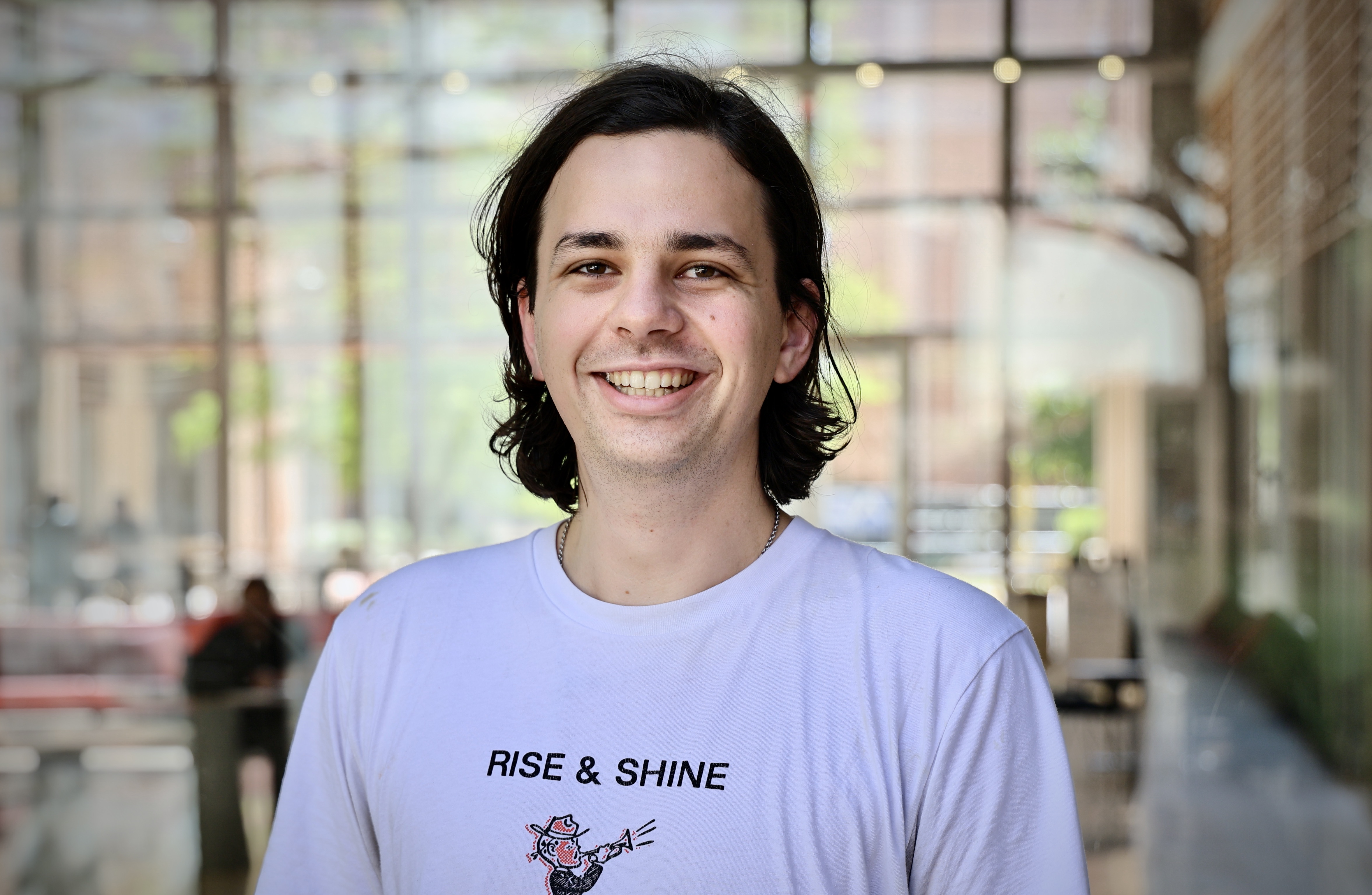
Evan is a PhD candidate from Chapel Hill, North Carolina. Before coming to UT Austin, he graduated summa cum laude from Emory University with degrees in applied mathematics and computer science. He currently works on prior-driven methods for optimal experimental design and Bayesian inverse problems, with applications in medical imaging.
Event information
Wednesday Jan 28, 2026